A cosmetic bottle is usually judged before it is touched: the silhouette sets the price expectation, the decoration confirms it, and the closure decides whether the user keeps it. That is why format and decoration should be chosen together rather than sequentially. This guide covers the decoration methods that work on glass, the dropper and perfume formats that carry them best, and the sequence that keeps a launch on schedule.
Decoration methods and what each one costs you
Every decoration method adds a setup step, and on glass the setup is often the largest part of the invoice at low volume. The table below ranks them by setup cost and by the visual effect they produce, not by absolute price, because the price depends on the number of colours and the size of the print area.
| Method | Setup cost | Typical lead time | Look | Best for |
|---|---|---|---|---|
| Screen printing | Low, one plate per colour | +5–7 days on top of glass production | Opaque, crisp, limited colour count | Logos, dosage text, single-colour wordmarks |
| Frosting | Low to medium; whole-batch process | +3–5 days | Soft matte diffusion | Serums, candles, brands avoiding a clear bottle |
| Spray coating | Medium; colour bath and masking | +7–10 days | Solid or metallic colour over the whole body | Colour stories, limited editions, opaque coverage |
| Hot stamping | Medium to high; metal die | +7–10 days | Metallic foil, sharp edges | Luxury fragrance, gift sets, premium caps |
| Water-transfer decal | Medium; film and artwork per design | +10–14 days | Multi-colour illustration, fine detail | Complex artwork that screen printing cannot hold |
Two rules matter more than the method choice. First, decoration cost scales with the number of colours and with the number of SKUs, not with the number of pieces, so consolidating artwork across a range saves more than negotiating the glass price. Second, every added pass is a chance for rejection: a frosted bottle that is then screen printed has two inspection points, and the yield loss shows up in the unit price.
Dropper bottles for serum: capacity decides the dropper
Serum formats usually sit between 5 ml and 100 ml, with 30 ml as the commercial centre of gravity. The dropper itself has to match the neck finish and the fill volume:
- 18-410 and 18-415 neck finishes are the common cosmetic standards. The thread and bead dimensions differ, so the dropper is not interchangeable between them. Confirm the standard before ordering either part.
- Bulb droppers suit low-viscosity serums and oils; the dose per squeeze is set by the pipette bore, not by the bulb.
- Push-button or pump droppers suit higher-viscosity formulas and give a more repeatable dose, at a higher closure cost.
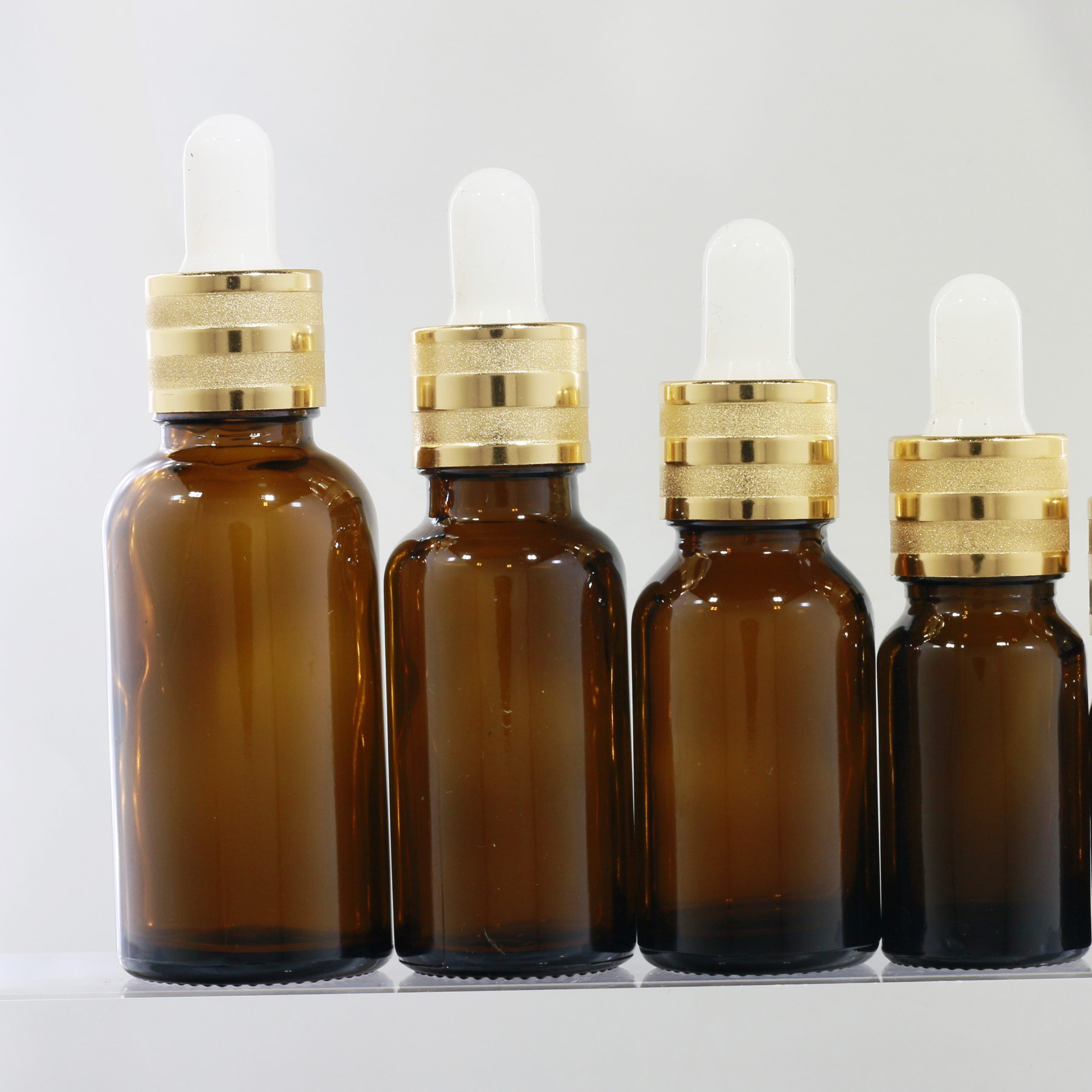
- Amber glass is the default for actives; clear or frosted glass is the default when the formula itself is the visual argument.
Capacity and dropper length interact: a 100 ml bottle with a short pipette leaves product unreachable at the bottom, while a long pipette in a 5 ml sample bottle wastes half the fill. Specify both the bottle and the pipette length in the same brief. Our serum bottle range and dropper bottle range list the standard combinations.
Perfume bottle sizes: what actually sells
Fragrance formats cluster around a small number of capacities because sampling, travel and full-size retail each have a different job:
| Capacity | Typical use | Format notes |
|---|---|---|
| 10–15 ml | Discovery sets, travel, samples | Thin wall is acceptable; crimp or screw neck |
| 30 ml | Entry full size, gift sets | Most common retail size in Asia and Europe |
| 50 ml | Core full size | Thicker base and wall for weight in hand |
| 100 ml | Value size, duty-free | Heavy base; check filled weight against freight limits |
Thick-wall perfume bottles are sold by weight as much as by volume: the base thickness is what makes a bottle feel expensive in the hand, and it is also what adds carton weight and freight cost. Decide the base thickness early, because it changes the mould, not just the decoration.
Matching decoration to format
| Format | Decoration that works | Decoration to avoid |
|---|---|---|
| Amber dropper bottle | One-colour screen print, small hot stamp on cap | Full-body light colours; the amber base fights them |
| Clear serum bottle | Frosting, fine screen print, metallic accent | Dense opaque coverage; it hides the formula |
| Thick-wall perfume bottle | Hot stamping, spray coating, heavy-base clear | Large decals across the curved shoulder |
| Glass jar | Screen print on body, frosting, lid decoration | Print across the jar thread or shoulder radius |
Approving artwork: five checks before plates are made
Most decoration problems are approved, not printed. Five checks catch them before a plate is cut:
- Minimum stroke width. Thin lines fill in on screen print. Keep positive strokes above roughly 0.3 mm and reversed text above 0.5 mm at final print size.
- Colour reference. Approve a Pantone reference rather than an RGB screen value. Glass, frosting and spray coating all shift colour, so the proof has to be on the same substrate as production.
- Print position tolerance. Glass is not paper: expect around ±1–2 mm of positional variation on a curved body. Keep logos away from the mould seam and from the shoulder radius.
- Process order. Frosting before printing, not after. Printing on a frosted surface needs a different ink cure and will not match a proof made on clear glass.
- Scanning and legal text. Check barcode and QR contrast on the actual decoration colour, and keep the ingredient list inside the flat print area where it stays legible.
The sample-to-production sequence
- Format and volume. Fix capacity, neck finish and closure type first. Changing any of them later resets the mould or the decoration plate.
- Artwork and dieline. Ask for the print dieline before designing. Text placed on a curved shoulder will distort, and a 1 mm logo stroke will fill in on screen print.
- Physical sample. Approve glass, colour and decoration as one sample, not as three separate approvals. A frosted bottle with a print proofed on clear glass will not match.
- Production. Standard production runs 15–20 days after sample approval, with decoration adding the lead times in the first table.
Three mistakes account for most launch delays: approving a closure that does not match the neck finish, ordering decoration colours below the MOQ threshold, and leaving the dieline until after the glass is produced. All three are avoidable with one consolidated spec sheet. If you are choosing between pump, dropper, spray and jar formats, start with our dispenser comparison; if the open question is order size or glass colour, the MOQ and material guide covers the numbers. For a quotation, send the capacity, closure and target market, and we will confirm the format and a 15–20 day window.