
Two bottles leave the same warehouse on the same pallet. Both are 50 ml, both are clear flint, both take the same 18-410 dropper. One weighs 68 g empty. The other weighs 112 g. A buyer holds them side by side, picks the heavier one, and then asks why it costs 40 percent more when “it is the same bottle.”
It is not the same bottle. Behind those 44 grams sit a different wall section at four measurement stations, a different annealing cycle, a different carton, a different freight bill, and usually a different kind of customer. Weight is the most visible number in glass packaging and the least understood one, because it is a result of the mould, not a design choice you make on a purchase order.
This guide is the technical version of the conversation we have with brands every week: what weight actually measures, where wall thickness lives, what extra grams genuinely buy, what they cost once freight is included, and how to write the number on a PO so that what arrives is what you approved.
1. What “weight” actually measures
Three different weights matter in a cosmetic glass project, and confusing them is where quoting goes wrong.
Empty weight (tare). The bottle alone, no cap, no pump, no label. This is the number that drives freight and the number a checkweigher sees. It is what suppliers quote when they say “this one is 96 grams.”
Gross weight. The filled, capped, labelled, retail-ready unit. Your carton weight limit, your pallet pattern and your shipping cost all live here. A 30 ml serum that weighs 58 g empty becomes roughly 95 g gross once you add a glass pipette, a collar, product and a carton divider.
Weight per unit volume. The ratio of grams to millilitres, and the only fair way to compare two quotations. A 96 g bottle at 100 ml is a heavier specification than a 152 g bottle at 200 ml, even though the second number looks bigger. Ask for the ratio before you compare prices.
2. Wall thickness is four measurements, not one
Wall thickness cannot be described with a single number, because a glass bottle is not a tube. It is pressed in a mould from a gob of molten glass, and the glass distributes unevenly by design: thicker at the heel where it meets the conveyor and the drop, thicker at the shoulder where the closure load lands, thinner across the body where the mould can control it best.

| Measurement station | What it controls | Standard wall | Heavyweight wall |
|---|---|---|---|
| Body sidewall | Weight, label flatness, resistance to dents and scuffing | 1.6 – 2.2 mm | 2.6 – 3.2 mm |
| Shoulder | Where the closure load is transferred; where most pressure cracks start | 2.2 – 3.0 mm | 3.2 – 4.0 mm |
| Heel and base | Drop survival, base chipping, conveyor abrasion | 2.4 – 3.4 mm | 3.6 – 4.6 mm |
| Neck and finish | Closure fit, not weight. Set by the T, E, I and H dimensions | Per GPI drawing | Per GPI drawing |
Two things follow from this table. First, “we made it thicker” is meaningless unless the station is named — a bottle can be heavier and still have a thin shoulder, which is exactly where it will fail. Second, the neck does not belong in a weight discussion at all. A finish is a closure interface, and it has to be specified to the drawing whether the body is light or heavy. If you have not pinned that interface down yet, read our guide to glass bottle neck finishes first; weight decisions come after.
Measured wall values are usually held to a tolerance of a few tenths of a millimetre, measured with an optical gauge or a magnetic thickness gauge on a sectioned sample. Wall is checked per cavity, not per batch, because the same mould can produce a heavier wall on one cavity than another if the gob temperature drifts.
3. Typical empty weights by capacity
The chart below is the range we are actually asked to quote for cosmetic formats. It is not a universal table: the same 100 ml bottle can be 88 g or 165 g depending on the mould, the finish and how much glass the body section was designed to carry.
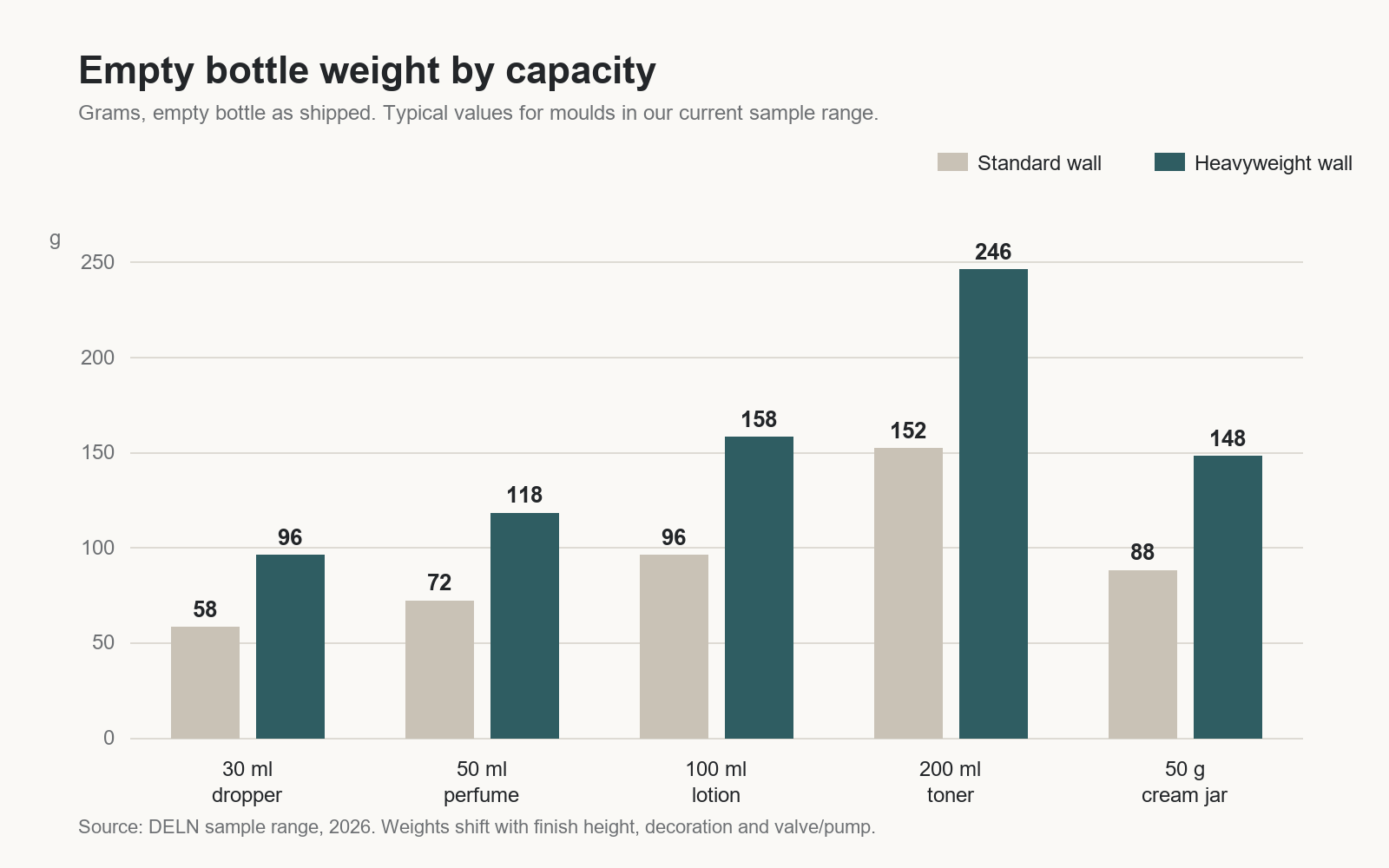
The pattern to notice is that the gap widens as the bottle gets bigger. On a 30 ml dropper, heavyweight adds roughly 38 g — a noticeable jump in the hand, but a small absolute cost. On a 200 ml toner, heavyweight adds close to 90 g per unit, which is the number that starts to show on a freight invoice and a pallet count.
4. Heavier is not the same as stronger
This is the most expensive misunderstanding in the category. Buyers assume that more glass means a tougher bottle. It does not, by itself. Strength in a glass container comes from three things, and mass is only the third.
Annealing. Every bottle passes through a lehr that reheats and slowly cools it to remove residual stress. A well-annealed 1.8 mm wall will survive a drop that cracks a badly annealed 3 mm wall. Residual stress is checked with a polariscope and graded; a supplier who cannot state the annealing grade is not controlling the variable that matters most.
Section geometry. Stress concentrates at corners, at abrupt thickness changes and at the shoulder-to-neck transition. A smooth, gradual section distributes impact far better than a blunt thick one. This is a mould design property, and it is why two bottles of identical weight can behave completely differently in a drop test.
Mass. Real, but third. Extra grams at the heel do help against base chipping and conveyor abrasion. Extra grams at the body mostly add weight and cost, not strength.
Practical consequence: if your problem is breakage in transit, the first questions are annealing grade, carton design and drop-test data — not “can you make it heavier?” Adding 20 g to a badly annealed bottle buys you a heavier broken bottle.
5. What the extra grams genuinely buy
Heavyweight is not a scam, but its benefits are specific:
- Hand-feel. The single real benefit in premium retail. A 112 g 50 ml flacon reads as “substantial” to a customer holding it at a counter, and that perception is what prestige pricing is built on. It is a marketing purchase, and worth paying for only where the product is handled before purchase.
- Reuse and refill durability. Brands selling refill formats or a bottle the consumer keeps for years get real value from a thicker body: less scuffing, less hazing, fewer chips at the neck after repeated washing.
- Decoration headroom. Frosting, organic coating and thick screen print all remove or add surface layers. A thin wall shows distortion and “orange peel” sooner under heavy coating.
- Thermal mass. A heavier wall holds temperature longer, which matters for hot-fill products and for formulas sensitive to a fast temperature swing on the line.
- Perceived stability on shelf. A heavier base lowers the centre of gravity and reduces the wobble that makes a tall bottle look cheap on a counter display.
Note what is not on that list: leak resistance, closure security, chemical compatibility and shelf life. None of those improve with wall thickness. They are decided by the finish, the liner and the seal — separate specification, separate money.
6. What the extra grams cost
Glass is sold by weight, so the first cost is obvious: heavier bottle, higher unit price. The second cost is the one buyers forget, because it arrives later and in a different currency column.
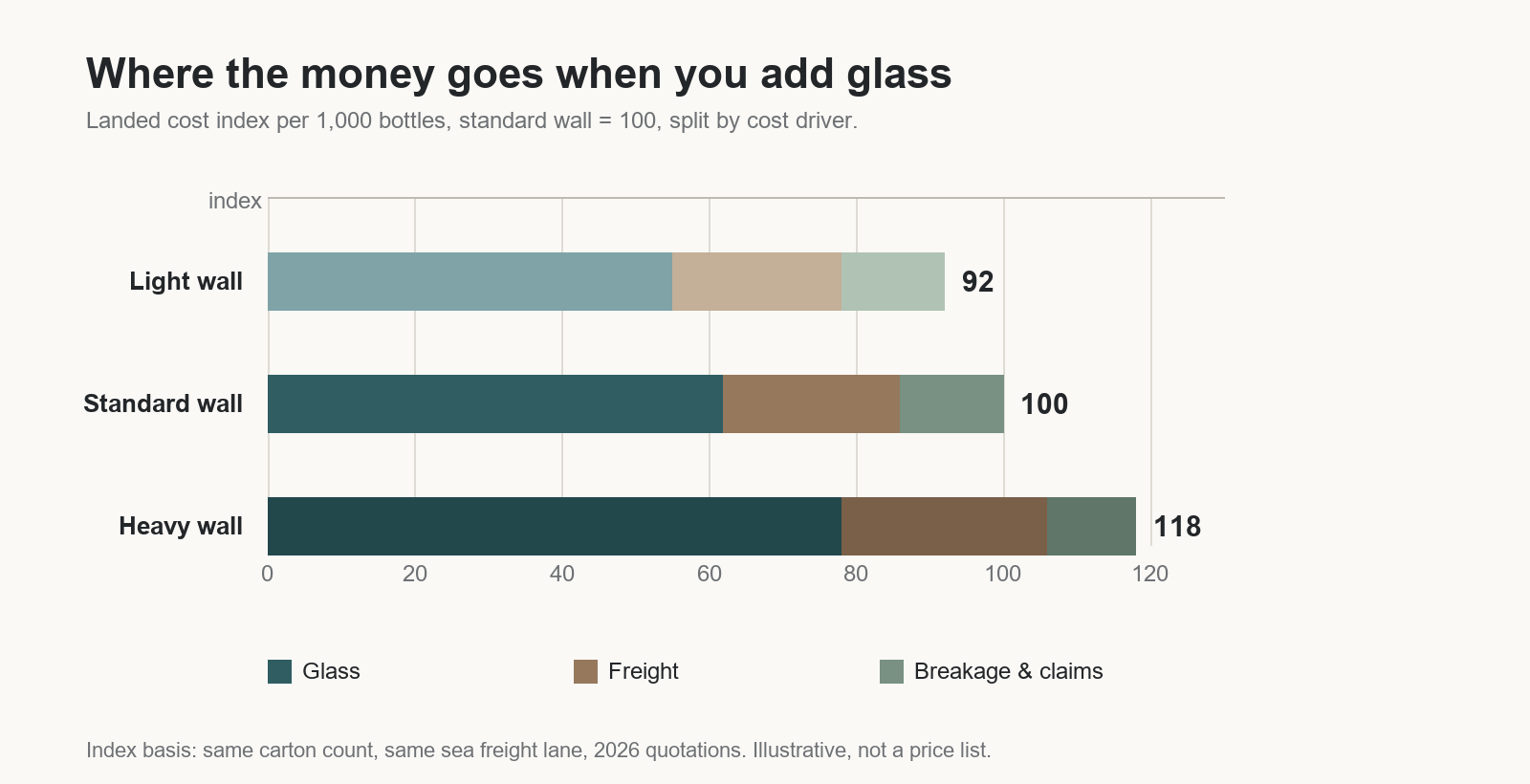
Read the chart as a ratio, not a price list. Moving from standard to heavyweight glass adds roughly 18 index points on a landed basis, and only about two thirds of that is the glass itself. The rest is freight, carton weight and the handling that goes with it.
The freight multiplier
Ocean freight for glass is charged on volume and weight together, and heavier bottles change both: the same pallet holds fewer units, and each carton weighs more. Two practical effects:
- Fewer units per pallet. A heavier bottle usually needs a thicker divider and a taller carton, so you ship fewer pieces per cubic metre. The freight cost per bottle rises even if the rate per container does not move.
- Air freight breaks the model. For a launch or a reorder shipped by air, weight is charged directly. Heavyweight glass can double the freight line on a small urgent shipment, which is why we usually recommend standard wall for first runs and heavyweight for replenishment.
Breakage: the one place heavy wins
The breakage segment is the only one that goes down as weight goes up, and only modestly. Thicker heels survive conveyor impacts and rough unloading better. But the effect is small compared with what proper annealing and a correct carton achieve, so do not buy weight as an insurance policy — buy the drop test data and the carton spec instead.
7. Weight and your filling line
Weight is a line parameter before it is a marketing parameter. Four places to check before you commit to a heavier bottle:
- Checkweigher setpoint. Fill weight is usually controlled by gross weight, so a heavier tare shifts the whole window. If your checkweigher runs a ±2 g band and the new bottle is 40 g heavier, the reject logic must be reconfigured, not just re-taught.
- Conveyor and accumulation. Heavier bottles increase rail pressure on accumulation tables and can cause jams at transfer points. Narrow-neck tall bottles with extra mass are the classic case.
- Capping torque. Torque settings are set against the bottle’s resistance to rotation. A heavier, stiffer bottle needs a different clutch setting; leave it and you will either under-torque (leaks) or over-torque (cracked shoulders).
- Labeler and sleeving. More mass means more inertia through the labeler; a rotary labeler may need its speed trimmed, and wrap-around labels may need a pressure adjustment to avoid skating on a heavier, glossier body.
All four are cheap to fix at the trial stage and expensive to discover on a live line at 60 bottles a minute. This is why we send physical samples rather than drawings alone.
8. Weight, PPWR and EPR: the regulatory push goes the other way
If your market is the European Union, the direction of travel is weight down, not up. The Packaging and Packaging Waste Regulation puts minimisation and recyclability at the centre of compliance, and extended producer responsibility fees are increasingly modulated by weight and material. A heavyweight bottle is a heavier fee base in several member states, and a thicker wall can work against recyclability targets if it pushes the container outside the accepted colour and contamination ranges.
That does not make heavyweight illegal. It makes it a decision you should be able to defend: if you are selling prestige fragrance in a retail environment where hand-feel is part of the product, the extra mass is a legitimate design choice; if you are selling a 200 ml toner through e-commerce, it is usually money spent against your own sustainability reporting. Our breakdown of EU PPWR and cosmetic glass covers the compliance side in detail.
9. How to specify weight on a purchase order
Weight is the specification most often left off a PO and most often argued about at delivery. Six lines fix it.
| Specification | How to write it | Why it matters |
|---|---|---|
| Empty weight | 96 g ±5%, weighed on 10 pcs per pallet, bottle only | Drives freight and perception; a free-hand “about 95 g” is not a spec |
| Wall at four stations | mm with tolerance, station named, datum defined | An inspector can check it; “thick glass” cannot be checked |
| Weight per 100 ml | g per 100 ml of nominal capacity | Only way to compare quotes across different sizes |
| Annealing grade | Residual stress grade from polariscope inspection, stated per batch | Decides strength far more than mass does |
| Drop test | ISTA 3A, 0.8 m, three orientations, report attached | Turns a claim about toughness into evidence |
| Carton and pallet | Max kg per carton, units per pallet, divider type | Weight becomes cost here; also a manual handling limit |
One more line worth adding: which weight the number refers to. Suppliers sometimes quote a target weight that includes the cap, and a 6 percent difference appears at goods-in with no one at fault except the drawing.
10. What our QC actually measures
Weight and wall are process outputs, so they are controlled at the machine, not at destination. On a running order we check:
- wall thickness at the four stations, per cavity, on first-off parts and at every shift change
- empty weight on sampled pieces from every cavity, against the PO tolerance band
- annealing grade by polariscope on a sample per lehr pass
- neck dimensions by go/no-go gauge on T and I, with full measurement on first-off
- 100 percent visual inspection for cords, checks, stones and mould seams
- drop test to ISTA 3A on the packed carton, not the bare bottle
- a retained golden sample of the approved bottle, cap and liner, kept for the life of the project
That golden sample is the most useful thing a brand can ask for. When a dispute happens two years later about whether a replacement run is “heavier” or “thinner”, the answer is a bottle on a shelf with a dated label and a weight written on it.
11. Choosing light, standard or heavyweight
There is no universally correct wall. There is a correct wall for a channel, a price point and a filling line. This is how we frame it with brands:
| Channel and positioning | Recommendation | Reason |
|---|---|---|
| E-commerce skincare, masstige pricing | Standard | Nobody holds it before buying; weight adds freight, not conversion |
| Prestige fragrance, retail counter | Heavyweight | Hand-feel is part of the product; the counter is where the decision happens |
| Refill and multi-use programs | Standard, or heavy if reused more than five cycles | Abrasion and washing wear the body; durability is a genuine cost saving |
| Travel, sample and gift-with-purchase | Light | Air freight and multi-unit sets; grams multiply fast |
| Sustainability-led brand, EU market | Light or standard, documented | Minimisation and EPR fees reward lower weight; defensibility matters |
| Holiday sets and gifting | Heavyweight | One-off purchase, unboxing impression carries the price |
12. Red flags in a quotation
- “Heavy glass” with no gram figure. An adjective is not a specification. Ask for the number and the tolerance.
- A weight that includes the closure. You cannot compare it with a bottle-only quote, and it hides a lighter body.
- No annealing grade. Suggests strength is being sold as thickness rather than controlled as a process.
- Wall quoted as an average. Averaging four stations hides the thin shoulder that will fail first.
- Same weight quoted for two different capacities. Usually one drawing is a scaled-up version of the other, and the section is wrong at one of them.
- No drop-test report. If a supplier cannot produce ISTA 3A data for the packed carton, the “strong bottle” claim has no evidence behind it.
13. Quick answers
- Is a heavier bottle always better quality? No. It is better hand-feel. Quality is annealing, section design, finish and seal.
- Can I just ask my supplier to add 20 g? Not on an existing mould. Weight comes from the mould section; changing it means a new mould, and the finish has to stay identical.
- Does heavier glass reduce leaks? No. Leaks come from the finish, the liner, the seal type and capping torque.
- What weight should I put on a 100 ml lotion bottle? A common standard-wall range is 88 to 105 g; heavyweight variants run 140 to 165 g. Specify from a drawing, not from a range you read online.
- How much does the extra weight add to freight? Budget for more than the glass delta: fewer units per pallet plus a heavier carton usually lands the total around 15 to 20 percent above standard wall on the same lane.
- Can I mix light and heavy in one order? Yes, but they are different moulds with separate MOQs, and usually separate pallet configurations.
14. Why brands bring weight and wall projects to DELN
We have been producing cosmetic glass packaging for more than 20 years, and the weight conversation is one we have often enough that we built the process around it:
- in-house mould development, so a wall section can be designed for a channel rather than inherited from a catalogue
- annealing grade reported per batch, with polariscope records available on request
- wall and weight taken as controlled process outputs, checked per cavity, not per delivery
- drop testing to ISTA 3A on the packed carton, so you see the number you are paying for
- physical sample kits with the real gram figure written on the bottle, so your team can feel the difference before committing to a mould
If you are weighing up light, standard and heavyweight for a launch, send us the capacity, the channel and your filling line details — we will come back with a wall recommendation, a gram figure with tolerance, and the freight implication of each option. Contact us or message us on WhatsApp at +86 182 0088 4050.
Further reading: MOQ and material guide · What mould tooling really costs.