Every brand that wants its own bottle shape reaches the same fork in the road, usually without noticing it is a fork. One route is to pick from the moulds the factory already runs — thousands of shapes, no tooling invoice, samples in two weeks. The other is to pay for a private mould, which buys you a silhouette nobody else can sell, and commits you to a number that decides whether the project is viable at all.
The mistake is treating tooling as a one-off engineering fee. A mould is not a cost line; it is a volume contract in disguise. An 8,000 USD mould spread over 20,000 pieces adds 0.40 USD to a bottle that sells for 1.20 USD — a 33% margin hit that never appears on the tooling invoice. Spread over 200,000 pieces it adds four cents and disappears. Same mould, same factory, two completely different businesses.
This is the guide we use when a brand sends a reference photo and asks, “can you make this?” It covers what a glass mould actually is, how cavity count sets your minimum order, what tooling really costs in 2026, the lead time nobody budgets, and the six tests to run before you pay for anything.
1. First, the two moulds people confuse
When a brand says “mould,” it usually means one of two unrelated pieces of tooling that live in different factories and are quoted by different suppliers.
The glass mould is heavy cast iron or bronze tooling installed on a glass forming machine. It shapes the bottle itself out of a 1,000 °C gob of molten glass. This is the mould that costs 2,000–8,000 USD, runs for hundreds of thousands of pieces, and is what the rest of this article is about.
The injection mould shapes the plastic parts — the pump, the dropper cap, the spray actuator, the jar lid, the shrink sleeve. It belongs to the closure supplier, not the glass plant. A pump mould might be 3,000–12,000 USD with 8–16 cavities, and it is a completely separate negotiation with a completely separate lead time.
The two must be specified together but bought separately. A brand that approves a glass bottle with a 24/410 neck and then discovers the pump they wanted only exists in 20/410 has bought a mould it cannot use. The neck finish is the contract between the two toolings — our neck finish guide covers the thread and bead dimensions that make the marriage work.
2. How a glass bottle is actually formed

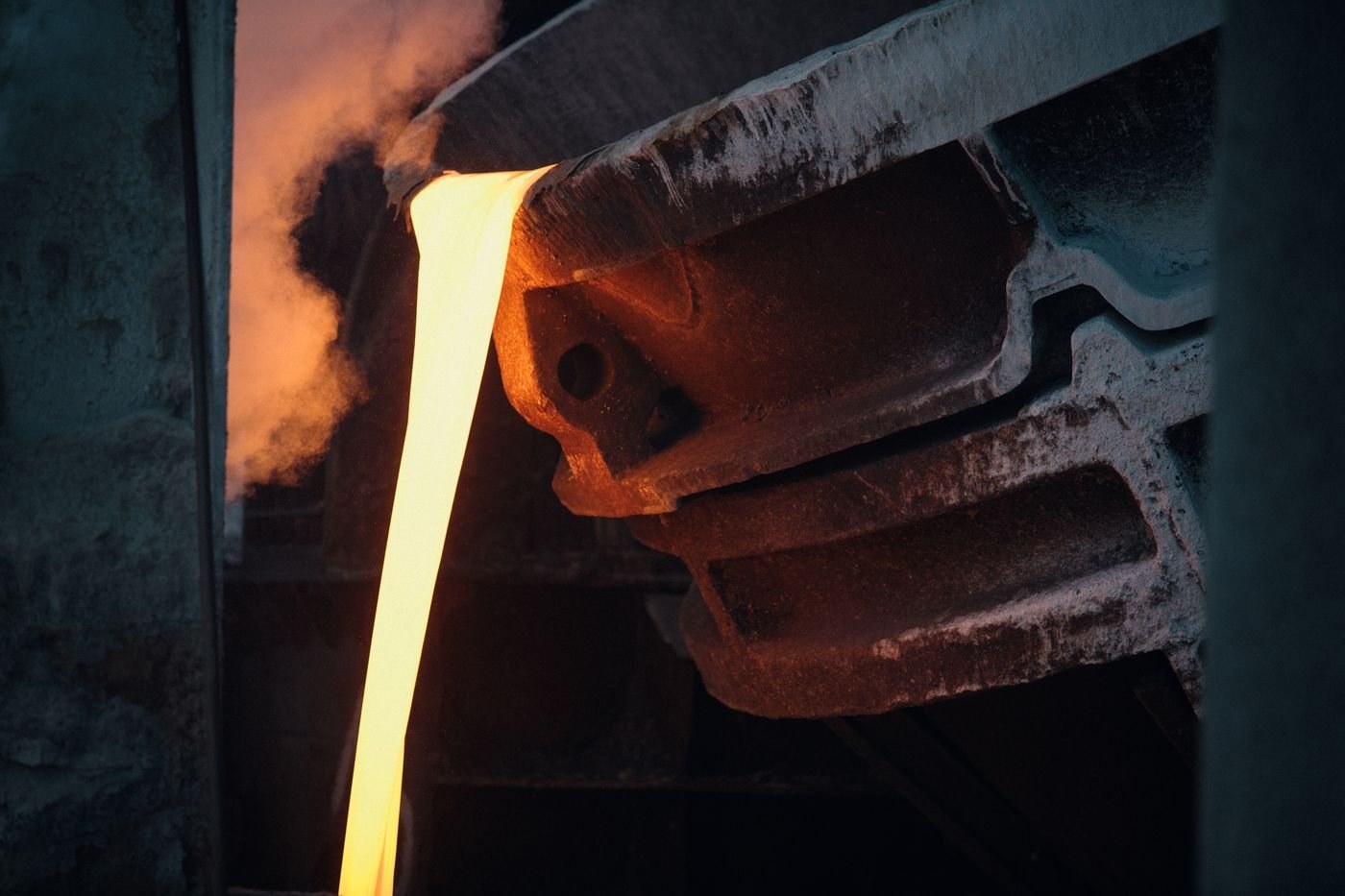
A parison — the gob of glass shaped before it is blown to final size. On an industrial line this step happens inside a blank mould, in under two seconds. Photo: Pexels.
On a modern IS machine (individual section machine, the standard for cosmetic containers), each bottle is made in two mould stages, one after the other, in the same section:
Blank mould (parison mould). A precisely weighed gob of glass drops into the blank mould. Compressed air or a plunger presses it into a rough pre-form — the parison — which already carries the neck finish, because the neck is the one dimension that must never be re-shaped afterwards.
Blow mould. The parison is inverted, transferred to the blow mould, and expanded with air against the cooled mould wall until the glass touches everywhere and freezes into the final silhouette. Wall thickness distribution is decided here, by how the parison was made and how the air was released.
Two consequences follow from this, and both cost money if ignored. First, the neck finish is set in the blank mould, so changing your closure means changing the blank mould — not just the blow mould. Second, the wall thickness you approve on a sample was produced by one specific pair of moulds running at one specific speed; when the plant speeds up to hit a delivery date, thickness drifts. That is the subject of weight and wall thickness, and it is the reason the drawing, not the sample, is the legal document.
3. Cavity count is really a decision about MOQ
Moulds on a forming line. Every cavity in a set produces one bottle per machine cycle — and the whole set must run together. Photo: Pexels.
A 6-cavity mould does not make one bottle six times faster. It makes six bottles at once, every cycle, whether you need them or not. The machine cannot run two cavities and idle four. That single mechanical fact is what sets your minimum order quantity, and it is why a small brand should think about cavities before it thinks about shape.
| Cavities | Typical minimum run per colour | Changeover loss | Realistic user |
|---|---|---|---|
| 2-cavity | 2,000–4,000 pcs | Low, long cycle time | Large jars, heavy flacons, first launches |
| 4-cavity | 4,000–8,000 pcs | Moderate | Serum and dropper bottles, indie brands |
| 6-cavity | 6,000–12,000 pcs | Moderate | Lotion and toner bottles, established lines |
| 8-cavity | 8,000–15,000 pcs | Higher, tighter windows | High-volume flint bottles, private label |
The numbers above assume one colour, one decoration run, one delivery window. Add a second colour and you add a furnace change, a cleaning cycle and a scrap ramp — typically 8–15% of the run volume lost before good bottles appear. This is why “can we do 1,000 pieces in amber?” is a different question from “can we do 1,000 pieces in flint?” Our MOQ guide goes through the arithmetic of what a realistic first order looks like.
4. What tooling actually costs in 2026
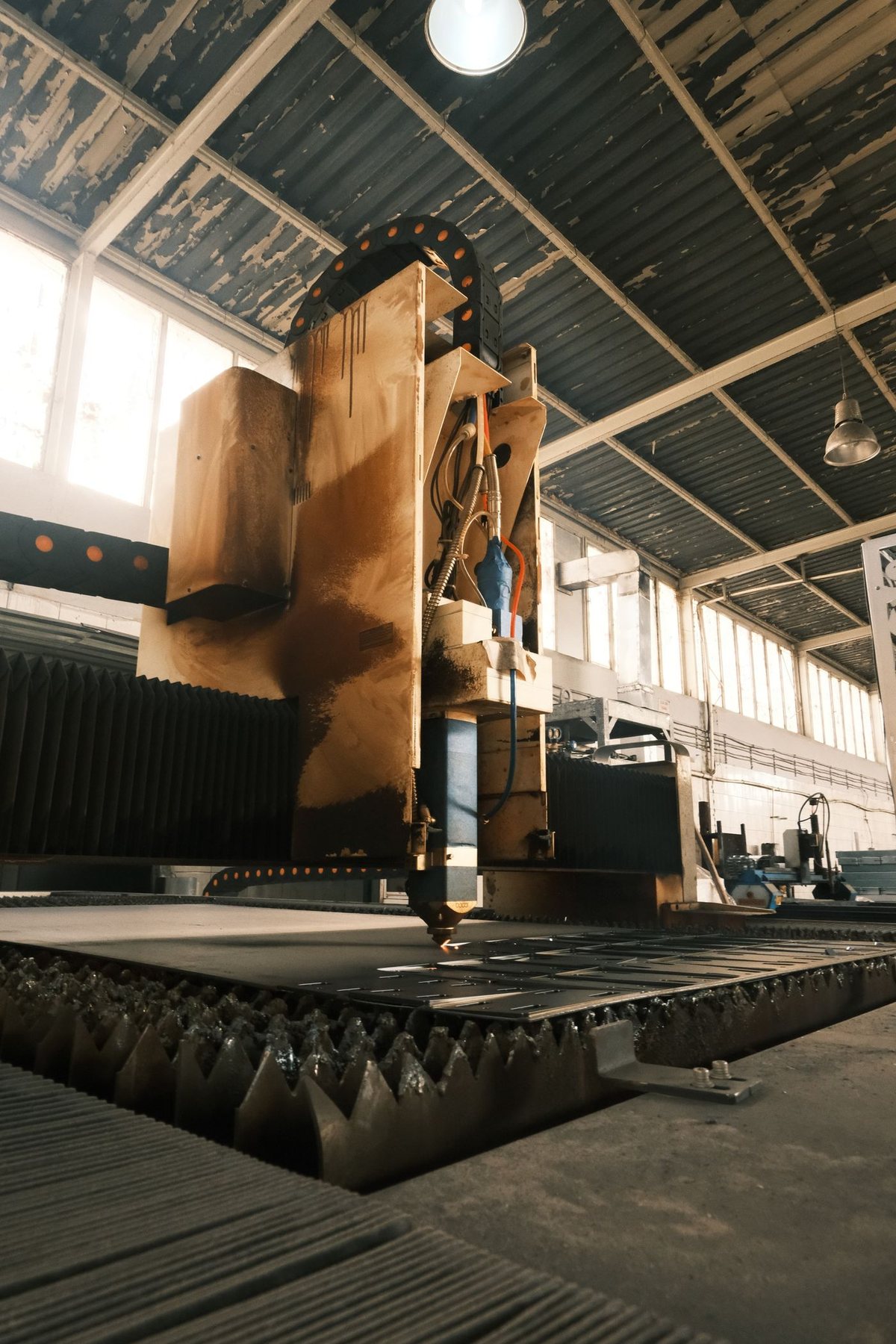
Mould machining. Blank and blow moulds are cut from cast iron or bronze blocks, then hand-polished and coated — the polishing is where tolerance is won or lost. Photo: Pexels.
A complete set means both blank moulds and blow moulds for every cavity, plus the neck ring, baffle, funnel and guide plates that hold them. Prices below are FOB China ranges for a first set, standard round or oval shapes, one colour, no special coating. They are market ranges, not a quotation — shape complexity, tolerance and polishing move them by 30–60%.
| Bottle type | Cavities | Tooling range (USD) | Cost per cavity |
|---|---|---|---|
| 15–30 ml dropper bottle, 18/415 | 4 | 2,400–4,500 | 600–1,100 |
| 50–100 ml lotion bottle, 24/410 | 6 | 4,000–7,000 | 650–1,200 |
| 30–50 ml perfume flacon, crimp neck | 4 | 3,500–6,000 | 850–1,500 |
| 100–200 ml cream jar, wide mouth | 2 | 2,800–5,000 | 1,400–2,500 |
| Non-round, embossed or double-wall shape | 4 | 5,000–9,500 | 1,250–2,400 |
Where an 8,000 USD invoice actually goes, on a typical 6-cavity lotion bottle:
Illustrative split of a mid-range 6-cavity set. The 23% spent on trials is the part brands underestimate — two rework rounds can double it.
5. Lead time: the stage nobody budgets
Tooling is not the bottleneck in a private mould project; the sampling loop is. Each approval round is a full cycle: adjust the mould, run trial glass, check dimensions, ship samples, wait for the brand to react. Three rounds is normal. Three rounds is also 6–8 weeks on top of the mould itself.
| Stage | Days | What can go wrong |
|---|---|---|
| Drawing & DFM review | 5–10 | Undercut walls, neck too thin to hold the thread |
| Mould machining & assembly | 18–30 | Bronze blank mould backlog at the tool shop |
| First trial run (200–500 pcs) | 3–5 | Line time lost to a scheduled colour change |
| Courier samples to brand | 4–7 | Customs holds on glassware |
| One rework round | 7–12 | Feedback arrives as a photo, not a measurement |
| First-time private mould, total | 45–75 | Quoted as 30 days, delivered as 60 |
| Existing mould sampling only | 12–20 | Waiting behind another brand’s scheduled run |
Two practical rules come out of this. Ask for the trial run before the mould invoice is fully paid, and make the second payment conditional on dimensional data from all cavities, not on a photograph. A brand that approves on photos approves a bottle, not a production process.
6. Six tests before you pay for a new mould
Roughly a third of the private moulds we see commissioned did not need to exist. The shape existed, or 90% of it existed, in a mould the plant already runs. Run these six tests first, in this order.
1. Neck finish. Does your closure exist in a standard neck — 18/415, 20/410, 24/410, 24/415, 28/410? If yes, choose the mould that matches the neck, not the one that matches the silhouette. Changing a standard neck to a custom one adds a blank mould and a closure mould at the same time.
2. Fill line. Your filler sets the height tolerance, the labelling machine sets the diameter tolerance. If the existing mould is within those windows, the private mould buys nothing but aesthetics.
3. Cavity and colour. Can the plant give you the cavities you need, in the colour you need, inside your window? A 4-cavity set on a flint run is a different product from the same set on an amber run.
4. Decoration fit. Frosting, coating, hot stamping and screen printing all need fixtures. A custom silhouette with no fixture means a second tooling budget you have not seen yet — see logo printing and decoration for what each process adds.
5. Exclusivity. If the mould is shared, ask who else buys it. A bottle used by six brands at six price points is not a brand asset, whatever the catalogue says.
6. Quality history. Ask for the rejection rate of that item over the last two runs. A shape that looks clean on a sample and runs at 12% reject is a shape that will be re-priced halfway through your second order.
7. Ownership, custody and mould life
This is the part of the contract that decides what happens when you change suppliers, and it is almost always left unwritten.
| Clause | Ask for this | If it is missing |
|---|---|---|
| Ownership | “Tooling paid by buyer remains buyer property” | Plant can reuse your mould for another client |
| Custody & storage | Who stores it, who insures it, storage fee after 12 months | A mould “lost in the warehouse” after two quiet seasons |
| Transfer right | Right to move the mould to a second plant, at your cost | Every future quote is single-sourced |
| Maintenance | Polishing interval, who pays, refurbishment price | Wear is billed as a “quality issue” on your PO |
| Life & records | Expected life in pcs, cavity numbers, drawing revision | No way to prove the bottle changed after run three |
On life: a well-maintained cast iron set for a 50 ml bottle typically runs 250,000–600,000 pieces before it needs re-polishing or replacement, less for abrasive amber glass and more for flint. Refurbishment usually costs 15–25% of the original invoice. A supplier who cannot tell you the cavity numbers or the last polishing date does not have a maintenance record — which means the drift you measure in year two has no documented baseline.
8. Tolerance: the numbers to put on the drawing
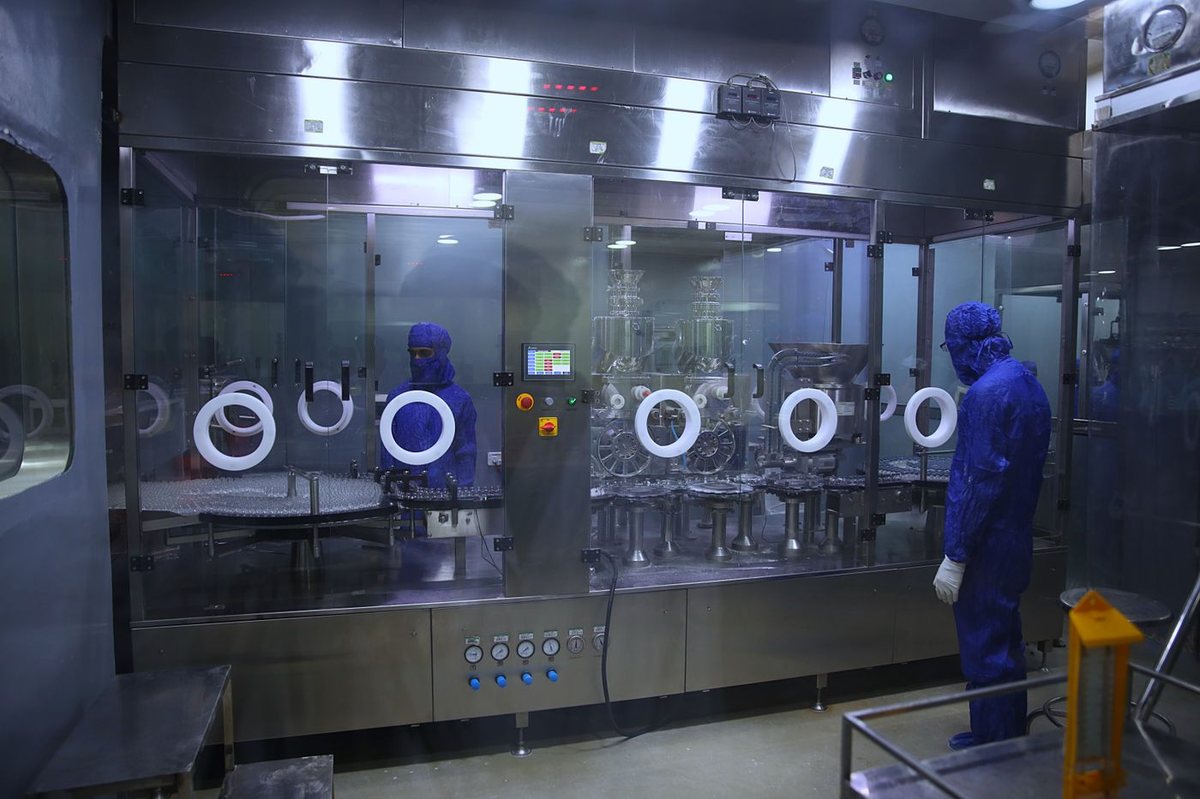
Automated inspection catches dimensional drift and cosmetic defects, but only against a specification. Without a drawing, it inspects against nothing. Photo: Pexels.
On glass, tolerance is not a preference; it is the difference between a bottle that runs on your line and one that jams it. Values below are what a competent plant will accept on a cosmetic container, and what should be printed on the drawing attached to the PO.
| Parameter | Typical tolerance | What breaks when it drifts |
|---|---|---|
| Overall height | ±0.6–0.8 mm | Pick-and-place, carton count, cap clearance |
| Body diameter | ±0.4–0.6 mm | Labelling, sleeving, gift box fit |
| Weight | ±4–5% | Freight cost, glass cost, fill weight claims |
| Neck ID / OD | ±0.15 mm | Pump or dropper leakage, capping torque |
| Verticality / concentricity | ≤0.4 mm | Label skew, cap cross-threading |
| Minimum wall | 1.0 mm body, 0.8 mm shoulder | Thermal shock cracks, breakage in transit |
| Cavity-to-cavity variation | Within the same tolerance, per cavity | One cavity in six leaks; the batch is scrap |
Ask for the measurement report per cavity, not the average. Averages hide the one cavity that ruins the run, and the mould cannot be fixed after the invoice is settled without a new argument.
9. Five lines that end the debate
When a brand is deciding between an existing mould and a private one, this is the summary we send back:
1. If the closure is standard and the bottle fits your filler, an existing mould wins on every axis except exclusivity.
2. A private mould only pays back above roughly 15,000–25,000 pieces; below that, the tooling is a per-unit markup, not an investment.
3. Cavity count sets MOQ. Choose the smallest set that still meets your annual volume, then negotiate the run size.
4. Budget 45–75 days for first-time tooling and 12–20 days for sampling an existing mould. Anything quoted faster is a promise, not a schedule.
5. Own the mould in writing, with cavity records and a maintenance interval. The drawing, not the sample, is the document that survives.
Get those five right and the bottle you receive in six months is the bottle you approved. Get them wrong and the cheapest mould on the quotation turns into the most expensive line in the project.
Photographs in this article are from Pexels and used under the Pexels licence. Cost and lead-time figures are market ranges for reference, not a quotation.
Further reading: Glass packaging MOQ and material guide · Neck finish dimensions explained.