Most glass packaging decisions come down to three questions a buyer asks in the first email: how many pieces do I have to take, should the glass be amber or clear, and is glass actually the right material for this product. Each answer changes the quotation, the lead time and the shelf presence of the finished bottle. This guide answers all three with the numbers and trade-offs we use when quoting cosmetic glass packaging, so you can size a first order without over-committing.
What a 5,000-piece MOQ actually covers
A 5,000-piece minimum order is measured per SKU, not per purchase order. A 30 ml dropper bottle in amber is one SKU. The same bottle in clear glass is a second SKU. Add a frosted finish and it becomes a third, because frosting is a separate production pass. Three colours of the same shape therefore means 15,000 pieces, not 5,000.
The number is driven by production economics rather than by a sales rule. A glass line runs a colour change by emptying the furnace channel and re-establishing the temperature curve, which costs several hours of output. Decorating adds a second setup: a screen or pad plate has to be mounted, aligned and proofed against the artwork. Quality control adds a third: an AQL sample plan is only meaningful across a continuous batch, so very short runs end up inspected almost piece by piece.
Below 5,000 pieces per SKU there are still two practical routes. The first is to choose a shape and colour the factory already runs, so your order joins an existing production run instead of paying for a changeover. The second is to accept a stock colour and put the differentiation into decoration, which has a much lower setup cost than a glass colour change. What does not work is asking for a private colour at 1,000 pieces and expecting the unit price to stay close to a stock item.
Amber versus clear glass
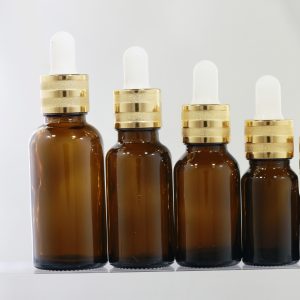
Amber glass is not a cosmetic choice; it is a barrier choice. The amber tint filters a large share of ultraviolet and short-wavelength visible light, which is what degrades vitamins, essential oils, citrus notes and many fragrance compounds. Clear glass lets that light through, so the formula itself has to carry UV filters or the pack has to sit in an opaque carton.
| Factor | Amber glass | Clear glass |
|---|---|---|
| Light protection | High — filters most UV and short-wavelength light | Low — relies on formula UV filters or secondary packaging |
| Product visibility | Low; colour reads dark | High; formula colour, emulsion and particles are visible |
| Perceived positioning | Apothecary, clinical, natural, essential oil | Clean, premium, fragrance, serum |
| Best fit | Essential oils, vitamin C, retinol, botanical extracts | Fragrance, clear serums, micellar water, gift sets |
| Custom colour options | Amber is standard; other tints are custom runs | Clear is standard; frosted, tea, blue and green are custom |
Clear glass is the better choice when the formula itself is the selling point — a bright emulsion, a suspended serum, a perfume with a pale tint. Frosting gives most of the light diffusion of amber without changing the colour reading, but it does not block UV, so it is a visual treatment rather than a barrier.
Glass versus plastic
Glass wins on inertness and on recycling quality. It does not react with essential oils or alcohol-based fragrances, it does not absorb odours, and it can be recycled indefinitely without downgrading. Those properties are why fragrance and premium skincare still default to glass even when plastic is cheaper per unit.
Plastic wins on weight and on short runs. A 50 ml PET bottle can weigh a fraction of the glass equivalent, which matters on air freight and on e-commerce parcels. Tooling for a plastic bottle is also cheaper, so a 2,000-piece order is viable. The trade-off is perception and barrier: plastic is permeable to oxygen and some fragrance notes over time, and it reads as mass market next to glass on a shelf.
Regulation is pushing the decision further. The EU Packaging and Packaging Waste Regulation raises recycling and reusability requirements for packaging placed on the European market, and glass containers with mono-material closures are simpler to demonstrate as recyclable than multi-layer plastic. If Europe is a target market, that argument usually outweighs the freight saving.
Decision rules by product type
| Product | Default format | Why |
|---|---|---|
| Vitamin C, retinol, essential oil | Amber dropper bottle, 5–50 ml | Light-sensitive actives need the UV barrier |
| Hydrating serum, niacinamide | Clear or frosted dropper bottle, 30–50 ml | Formula colour and texture are the selling point |
| Eau de parfum | Clear thick-wall bottle, 30–100 ml | High alcohol content; glass is inert and the juice reads clear |
| Face cream, mask | Glass jar, 50–100 ml | Wide mouth for spatula or pump; thick wall feels premium |
| Lotion, body care | Lotion bottle with pump, 100–250 ml | Volume and dispensing rate drive the format |
Specification checklist before you place a PO
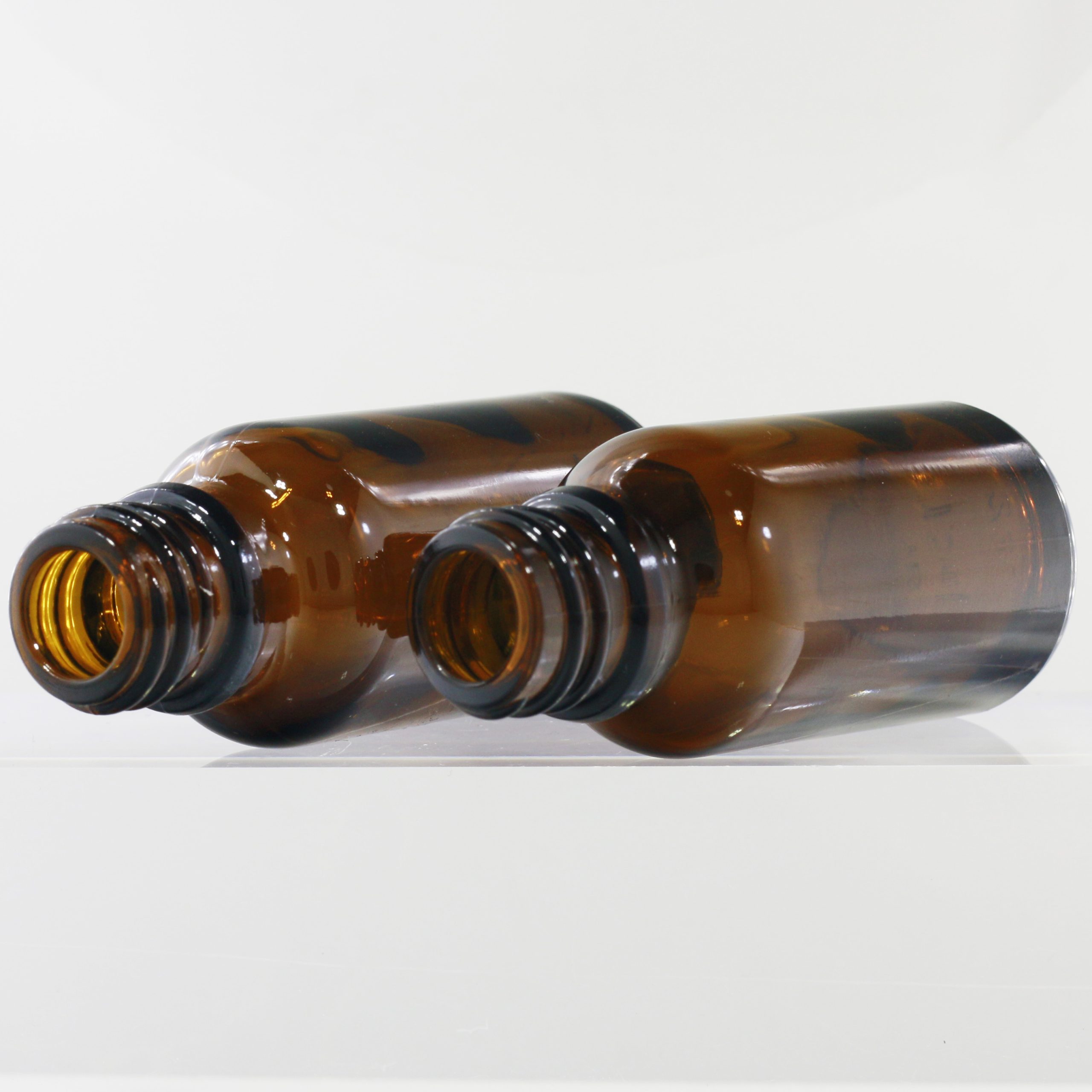
- Neck finish. Confirm the thread standard before approving a closure. An 18-410 bottle does not accept an 18-415 pump, and the mismatch is only discovered at filling. See our neck finish guide for the dimensions that matter.
- Capacity and tolerance. State the fill volume and the acceptable overflow capacity, not just the nominal size. A 30 ml bottle typically holds more than 30 ml to the brim.
- Wall thickness and weight. Heavier glass feels more expensive but adds freight and can slow the filling line. Our guide to bottle weight and wall thickness covers where that money is actually spent.
- Decoration position. Provide a dieline and keep critical text away from the curved shoulder, where print distortion is unavoidable.
- Compliance. For EU destinations, check the packaging recyclability requirements early rather than at artwork approval — see our PPWR 2026 summary.
The short version
Take 5,000 pieces per SKU, and count every colour and finish as a separate SKU. Choose amber when the formula is light-sensitive, clear when the formula is the visual argument, and glass when inertness or premium positioning outweighs freight. If you are still deciding between formats, our essential oil bottle range and glass jar range show the standard shapes and capacities behind these rules. For decoration options that suit each format, see the bottle decoration guide. Send the fill volume, the closure type and the target market, and we will confirm the format, the MOQ and a 15–20 day production window.